HOF CLASS OF 2026: 'No-nonsense, she did it all' – The Sis Paulsen story
August 18, 2026 | Women's Hockey, Andy Baggot
Julie Sasner had just been named the first coach in Wisconsin women’s hockey history when she made an important vow to herself.
“My number one goal was to get the best player in the state on my team,’’ she said. “I didn’t want any blue-chip, full-scholarship-type athlete leaving the state of Wisconsin.’’
So Sasner’s first recruiting trip took her from Madison to Eau Claire to visit Sis Paulsen, an undersized defender whose elite combination of skill and will had put her on the recruiting radar of Minnesota, Minnesota-Duluth, Ohio State and multiple programs from out east.
As soon as Paulsen made her official campus visit leading up to Wisconsin’s inaugural season in 1999-2000, she just knew the direction she wanted to go.
“I was pretty confident that’s where I wanted to go right from the start,” she said of UW. “It was a no-brainer for me.”
Paulsen proceeded to mix a nurturing spirit with an eye toward daily improvement. She became the first three-time captain in program history. She was chosen to the inaugural all-Western Collegiate Hockey Association first team and was voted Most Valuable Player by her Badgers teammates in 2000. She finished her career with a then-program record 130 points that included 42 goals and 88 assists.
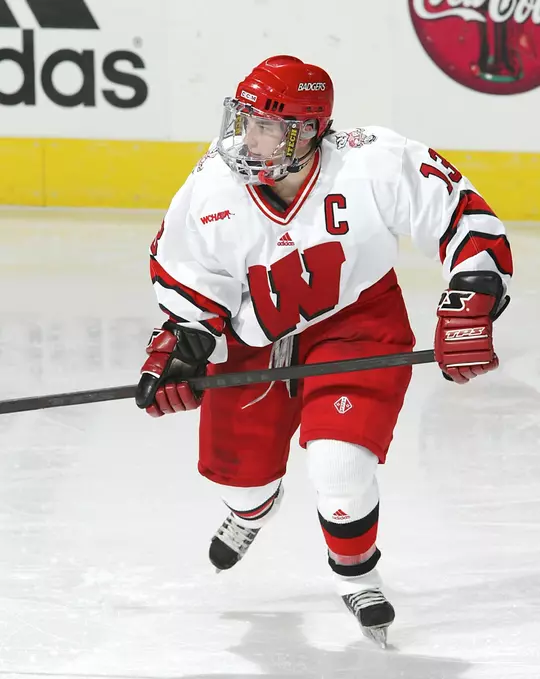
“Talk about a pioneer,” Sasner said. “She was all business. She was always like, ‘How do I get better and how does our team get better?’
“Sis was just no-nonsense. She did it all. She was a person of very few words and a lot of very positive actions.”
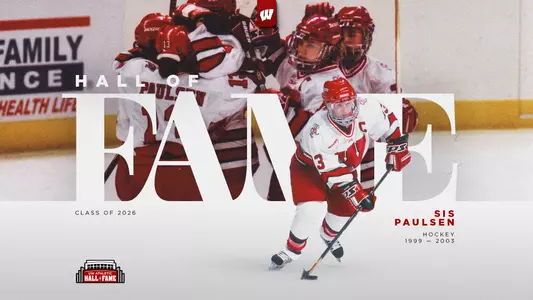
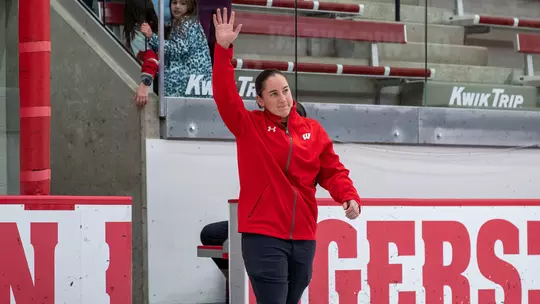
That kind of approach is why Paulsen is being inducted into the UW Athletic Hall of Fame. She helped coax the next collection of talent to Madison while creating the culture that ultimately brought nine NCAA championships banners to hang inside LaBahn Arena.
Paulsen was serving as a graduate assistant coach during the 2003-04 season when center Sara Bauer, the first Patty Kazmaier Award winner in program history, crossed paths with Paulsen.
“She was definitely one of the people that helped make me, as a young player, feel comfortable being part of this whole new environment,’’ Bauer said. “She always had a smile on her face. She had such great energy and a positive attitude.”
For someone listed at 5-foot-3, Paulsen made her presence felt in a variety of ways, setting an example for a team that was initially a mix of club players and partial scholarships recipients. She was known to play 30 minutes a game while playing a physical brand of hockey.
“She played on the edge,” Sasner said. “She wasn’t afraid of taking on anyone.”
Sasner wound up coaching Paulsen for one season before leaving to serve as an assistant coach for the U.S. women’s national team that played in the 2002 Winter Olympics. Interim Trina Bourget, a former UW assistant, took over as coach, but ultimately resigned while on medical leave in March of 2002.
“We were kind of disappointed because she had just started this thing,” Paulsen said of Sasner, “but we also knew that she was going to represent Team USA and be a part of the (Olympics).
“So, yeah, you’re disappointed because it was your first coach, the one who was essentially reason why I came (to play for the Badgers).
“Julie did a great job that first year. She did a great job recruiting and getting us a competitive team right off the bat.”
But the program’s culture changed forever when Mark Johnson, the Olympic gold medalist, NHL captain and the all-time leading goal scorer in UW men’s history, took over as women’s coach in 2002.
Johnson has won more than 700 career games, claimed nine NCAA titles and featured seven Patty Kazmaier Award winners as the best players in women’s college hockey.
“It was awesome and we were excited about it,” Paulsen said of Johnson’s arrival. “We didn’t know much about him. We knew he had been on the men’s side before and, obviously, we knew about his hockey achievements, but we didn’t know him much as a person.”
That changed in due time.
“Getting to know him our senior year was awesome,” Paulsen said. “He was, and still is, an unbelievable coach, the right guy for the job. He taught us so many day-to-day life lessons. I don’t know if I can give you an example, but just being a good human, a good teammate and battling through adversity. He made a huge impact on me.”

Paulsen, who graduated with a degree in human development and family studies, worked as the director of hockey operations for the Badgers before becoming the head equipment manager for the Minnesota Frost of the Professional Women’s Hockey League. She also has served as the equipment manager for the U.S. women's national team on several occasions, including at the 2022 and 2026 Winter Olympics.
“It’s awesome to be a part of watching women’s hockey take the leaps and bounds that it has from back when I played.” Paulsen said.
BEST OF THREE
One: What does it mean to be a UW Hall of Famer: “I don’t even know how to put that into words,” Paulsen said. “I’m so humbled and thankful, just to be along with some of the names that are in there.”
Two: She’s proudest of … what? “Hopefully it’s being a good teammate, being a good leader,” Paulsen said.
Three: Did Paulsen maximize her time at UW? “I would hope so,” she said. “I don’t think I have any regrets. It was the perfect school for me to grow as a hockey player and to grow as a human.”
At Camp Randall Stadium on Thursday, May 28, University of Wisconsin Interim Director of Athletics Marcus Sedberry revealed that Sis Paulsen will be inducted into the UW Athletic Hall of Fame as part of the Class of 2026.
The class of legendary Badgers will be inducted into the Hall of Fame later this fall during a weekend of celebration on September 18 and 19. The inductees will be honored inside Camp Randall Stadium during Wisconsin Football's meeting with Eastern Michigan (Sept. 19 – 11:30 a.m. CT).