Lucas: Tamara Moore continues to blaze trails in new coaching role
April 15, 2020 | Women's Basketball, Mike Lucas
Wisconsin hall of famer to coach men’s college basketball program
 |
||
|
BY MIKE LUCAS
UWBadgers.com Senior Writer
MADISON, Wis. — Scrutiny has never intimidated Tamara Moore. On the contrary. She has welcomed it. Driven by a pioneering spirit, the UW Hall of Famer has no qualms breaking down barriers; a history that bodes well today for the only woman running a men's program in college basketball.
"I know all eyes are going to be on me seeing what I can do," said the 40-year-old Moore after being hired as the head coach of the men's team at Mesabi Range College, a community college of 1,700 students in Virginia, Minnesota, an hour northwest of Duluth.
"I just had a reporter ask me, 'How are you going to handle some of the scrutiny that might come along with being a woman coaching young men?' For me, the biggest thing is that I've always had the respect of the people around me …"
Moore expects it to be no different at Mesabi Range, a member of the National Junior College Athletic Association. She will not be inheriting high expectations. The Norsemen were 6-19 last season prompting Moore to reason, "The only thing we can do is go up. I don't feel there's any pressure."
But later, she conceded, "I look at it as an opportunity to break down more barriers."
She also confided, "I've always been trying to change the culture everywhere I've been."
Asked if she has seen herself as a trailblazer, she said, "I have. I never set out to play basketball to do that. But it has been the role I've taken over the years of playing and it just kind of came natural. I will keep on wearing these shoes as long as people will allow me to keep walking in them."

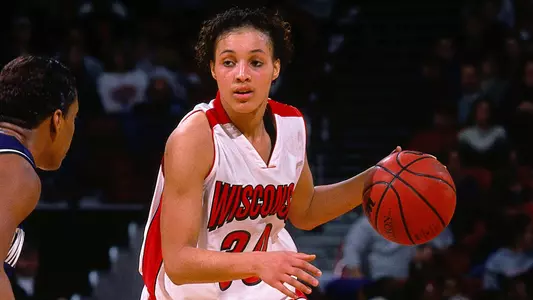
Moore's first steps were taken at Minneapolis North High School where she led her team to a state championship, the first inner-city school to win the title. As a senior, she was also the first girl to play in the boy's prep all-star game. From there, she went on to a record-setting career at Wisconsin.
Jane Albright, the winningest coach in UW history, was the catalyst in her growth.
"She put the ball in my hands," Moore said, "and told me to run with it."
Not only did the 5-foot-10 guard, a two-time team MVP, score 1,662 points — the seventh highest total on the school's all-time list — but she's still the career leader in assists (554) and steals (353). During her four seasons, she played in every game and the Badgers went 18-14, 21-12, 18-10 and 19-12.
This unprecedented stretch of success at Wisconsin — evolving around Albright's steady guidance and Moore's continued development as a point guard — featured two trips to the NCAA tournament and two to the NIT where the Badgers were the 2000 champion and 1999 runner-up.
"I was able to learn under the tutelage of Jane," said Moore, the 2001 Defensive Player of the Year in the Big Ten. "I also had a lot of chances to connect with Dick Bennett and Tony Bennett when they were there (Dick ran the men's program from 1995-2001 and Tony was on staff from '99-03).
"I watched a lot of (Bennet's) practices and was allowed to sit in on a lot of different workouts.
"Having Wisconsin as a support system from Day One was an open door to opportunity."
In 2002, Moore was a first-round pick (15th overall) of the Miami Sol in the WNBA draft. Although she left school without her undergraduate degree because of logistical conflicts playing professionally, she chipped away at it and finally earned her UW diploma in 2014.

"I know it was not the road most traveled," said Moore, whose mom inspired her to complete what she had started academically on the Madison campus. "She was happy with all the personal accolades as far as the MVP awards and the records and all the things like that.
"But it was never going to be as exciting to her as me getting my degree. That was always something we talked about being one of three kids and having my brother and sister pushing me forward to pursue a scholarship. My mom missed only five games in four seasons, home and away.
"And that diploma is on my wall now and still the most important thing for me."
In the WNBA, she played on seven teams in six seasons. She didn't have anywhere near the same success that she had at Wisconsin. But she never stopped learning the game from pro teammates, icons like Lisa Leslie, Diana Taurasi, Swin Cash and Sheryl Swoopes.
She was also coached by the likes of Bill Laimbeer, Michael Cooper and Joe Bryant (Kobe's dad).
"One of my biggest role models was Kevin Garnett, who played a really instrumental role when I first got into the WNBA," Moore said. "He was really supportive of our team (Minnesota Lynx) and really supportive of me as a player. I wore No. 21 in honor of him. He was always somebody I looked up to."
Another mentor was Tennessee's Pat Summitt, a Hall of Famer and winner of 1,098 games.
"She was someone who recruited me out of high school," Moore said, "and was one of the most legendary coaches in the sport. She probably had many offers to coach men's programs over the years. And she would have been excellent at it — she would have really excelled."
After her WNBA career, and stints playing overseas, Moore broke down another barrier when she became the first female player on the Minnesota Blizzards of the American Basketball Association. The team was owned and coached by Ben Coleman, also a Minneapolis North grad.
The ownership route appealed to Moore, who won a championship her second year as the owner and coach of the Twin Cities Elite, a men's semi-pro team. One thing led to another and Moore established her own league, the OBA (Official Basketball Association), which has 35 teams nationally.
"I have a lot of great supportive owners in the OBA and that helps a lot," said Moore, who credited her "passion for the game" leading to these types of business opportunities which expanded her resume and "created another door for me to take on this job at Mesabi."
The past two seasons, Moore has been the head coach of the girl's team at Edison High School in Minneapolis. "And what ended up happening was somewhat of a needle in the haystack (story)," she said of her path to Mesabi Range which was through one of her players being recruited in volleyball.
"The volleyball coach was Sara Matuszak who was recruiting one of my girl's, Serena Poisson. Sara was looking online to get information on our Edison program when she saw my name, and she asked Serena, 'Is that the same Tamara Moore who played at Minneapolis North and Wisconsin?'
"I come to find out that Sara was one of my former guidance counselors from high school."
That connection resulted in Mesabi offering the men's job to Moore, who will also be the head coach of the softball program. The Norsemen are one of 17 basketball-playing schools in the Minnesota College Athletic Conference that winds through Fergus Falls, Brainerd, Cloquet, Hibbing, et al.
"In this journey," Moore said, "the sport, itself, helped take me to the next level. It's an honor to take this step. I'm excited and my guys are excited. I've heard from a lot of people and my phone has died 17 times the last two or three days."

In the 1990s, Kerri-Ann McTiernan was a trailblazer; the first woman to be the head coach of a men's college team. In 2000, she won a title at Kingsborough Community College in Brooklyn, New York.
One of Moore's former WNBA teammates, Edniesha Curry, is an assistant at the University of Maine, the only woman presently coaching in D-1 men's basketball.
The NBA has 11 women serving as assistants from Becky Hammon (Spurs) to Teresa Weatherspoon (Pelicans). Cash is the vice-president of basketball operations in New Orleans.
"I pay a lot of homage to the Becky Hammons, the Teresa Weatherspoons, the Swin Cashs who have kind of trailblazed the way for all of this to even be a reality for me," Moore said. "They really opened the door to this next level and my ultimate goal is to help Mesabi win a championship."
Where might this all lead someday?
"To be honest, I'd like to take it all the way to a D-1 men's head coaching job," said Moore, who was inducted into the UW Athletics Hall of Fame in 2017. "I want it to be a starting point."
Another barrier, another stepping stone.